

Περιεχόμενα Άρθρου
One Stop Shop 2.0 – VAT E-commerce Rules EU
The European Commission, with the aim of strengthening the competitiveness of companies that keep stocks in multiple EU member states, submitted a proposal to extend the One Stop Shop service (single VAT registration in the EU) to One Stop Shop 2.0.
The European One Stop Shop (OSS) initiative has been a milestone in achieving the EU’s goal for the transition to a fairer, simpler, and more efficient tax system.
One core disadvantage, however, is that companies with warehouses in more than one EU country must still register with each country’s tax authority in which they hold stock.
The One Stop Shop 2.0 proposal eliminates this complex, time-consuming, and costly process.
Through the implementation of the One Stop Shop 2.0 proposal, companies that sell to consumers, and hold stocks in several EU member states, they will be allowed to register in an EU member state and complete their tax obligations through the single web portal.
The proposal was submitted by the European Commission on December 8, 2022, and is expected to be evaluated by the Council of the European Union.
Article to read:
One Stop Shop 1.0 – Single VAT Registration in the EU
The One Stop Shop 2.0 proposal is an extension of the single One Stop Shop (OSS) VAT digital portal which entered into force on 1 July 2021 by introducing several innovations, thus expanding the mini One Stop Shop (MOSS) that was operating from January 1, 2015*.
*The mini One Stop Shop service does not apply from July 1, 2021, and telecommunications, radio communications, and electronics supply services are now subject to the provisions of the One Stop Shop – Single VAT Registration initiative.
The European One Stop Shop initiative was created with the aim of redefining European e-commerce and at the same time contributing to a fairer, simpler, and more efficient tax system.
Article to read:
It amends the VAT rules on cross-border business-to-consumer (B2C) e-commerce activities to achieve this. The rationale behind these changes is to overcome barriers to cross-border online sales and address challenges arising from VAT regimes for distance sales of goods and the import of low-value consignments.
Who does One Stop Shop concern?
The One Stop Shop initiative simplifies tax compliance processes for all parties involved in the e-commerce supply chain. It is aimed at online sellers and online markets/platforms (within and outside the EU), postal operators and couriers, customs and tax authorities, to consumers.
One Stop Shop (OSS) – Main Innovations
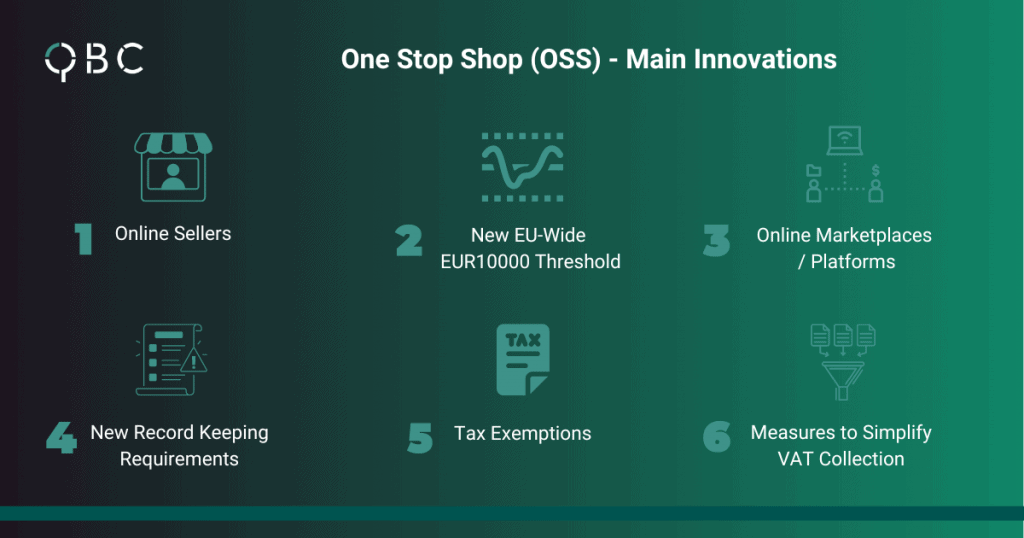
1. Online Sellers
Today, online sellers, as well as online markets/platforms can be registered in an EU member state. and through this, they can declare and pay VAT, i.e., comply with the tax provisions, for all distance sales of goods, as well as cross-border delivery services to customers within the EU.
2. New EU-Wide EUR10000 Threshold
The VAT thresholds for each country were abolished and, in their place, a single EU-wide threshold for distance sales of €10,000 was introduced. Below this threshold, supplies and services are taxed at the domestic VAT rate and VAT is paid in the respective country. Where distance sales exceed the EU-wide threshold, VAT is due in each country in which the goods are sold. In this case, you must also register for VAT in these countries.
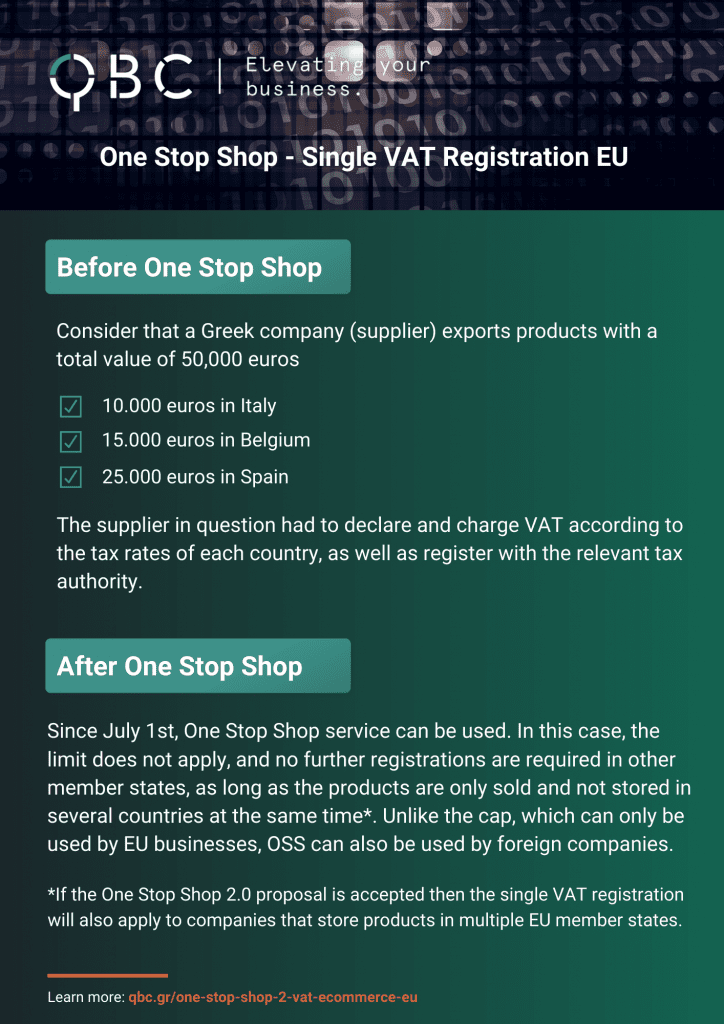
Alternatively, the One Stop Shop service can be used. In this case, the limit does not apply, and no further registrations are required in other member states, as long as the products are only sold and not stored in several countries at the same time. Unlike the cap, which can only be used by EU businesses, OSS can also be used by foreign companies.
Before One Stop Shop – Single VAT Registration EU Initiative
Consider that a Greek company exports products with a total value of 50,000 euros (worth 10,000 euros in Italy, 15,000 euros in Belgium, and 25,000 euros in Spain). The supplier in question had to declare and charge VAT according to the tax rates of each country, as well as register with the relevant tax authority.
Article to read:
3. Online Marketplaces/Platforms
In online markets/platforms that facilitate the buying and selling of goods, for tax purposes, the title of the supplier is assigned.
What is the Deemed Supplier?
The Deemed Supplier is a taxable entity that is not the actual supplier of the goods but participates in the purchase and sale by facilitating its completion (through an electronic interface) and is therefore, for taxation purposes, attributed the title of the supplier.
4. New Record-Keeping Requirements
New record-keeping requirements are introduced for online marketplaces/platforms that facilitate the procurement of goods and services, including where online marketplaces/platforms are not given the title of the supplier.
5. VAT Exemption
Through the initiative, VAT exemption when importing small consignments with a value of up to 22 euros is abolished. This means that all goods imported into the EU are subject to VAT.
6. Measures to Simplify VAT Collection
The Import One Stop Shop (IOSS) has been created to simplify the declaration and payment of VAT for distance sales of goods of low value, which do not exceed €150, and are imported from third countries. Special arrangements for distance sales of imported goods in consignments not exceeding EUR 150 have been established where IOSS is not used. The Import One Stop Shop service can be used by suppliers based in the EU, as well as by suppliers based in third countries.
How can QBC help you?
Following the latest developments in tax legislation and having the necessary know-how, QBC Tax Consultants are at your side to help you achieve maximum tax compliance and benefit for your business.
Through accounting outsourcing and supervision services, QBC supports businesses in evaluating and restructuring their existing accounting systems to make them more efficient and effective.
For more information on corporate tax and accounting, you can contact us by phone at 216 900 7576 or submit a contact request and one of our Consultants will serve you immediately.