


Περιεχόμενα Άρθρου
New NSRF 2021-2027
The new priorities of the European Commission and the new development priorities of Greece for the coming years are reflected in the new “Regional Development Corporate Agreement 2021 – 2027” (NSRF 2021 – 2027). After its approval by the European Commission, resources of a total amount of 26.2 billion euros will be available for our country for the next 7 years, of which 20.9 billion euros concern the Union Support and the amount of 5 .3 billion euros pertains to the National Contribution.
Greece is the first EU Member State to officially submit and have the “Corporate Agreement for Regional Development 2021 – 2027” approved for the new Programming Period.
The new NSRF 2021-2027 captures and sets priorities for strengthening the productive potential of the economy, infrastructure, human skills and strengthening social protection.
The projects – actions to be financed by the new NSRF take into account the special conditions and needs of the country for the coming years and respond to the structural shortcomings of the Greek economy. At the same time, major projects that were started in the framework of the NSRF 2014-2020 are continuing and being completed.
Key features of the new NSRF:
- It links with the European Semester and the Commission’s recommendations for co-financed programs,
- Following is the National Reform Program and Development Plan for the Greek Economy (Pissarides Committee Report),
- Supports other National Strategies and National Action Plans (Enabling Conditions),
- Supports the new Just Transition Fund (lignite regions and islands),
- It follows the restrictions of the European Regulations for thematic concentrations and exceeds the minimum percentages.
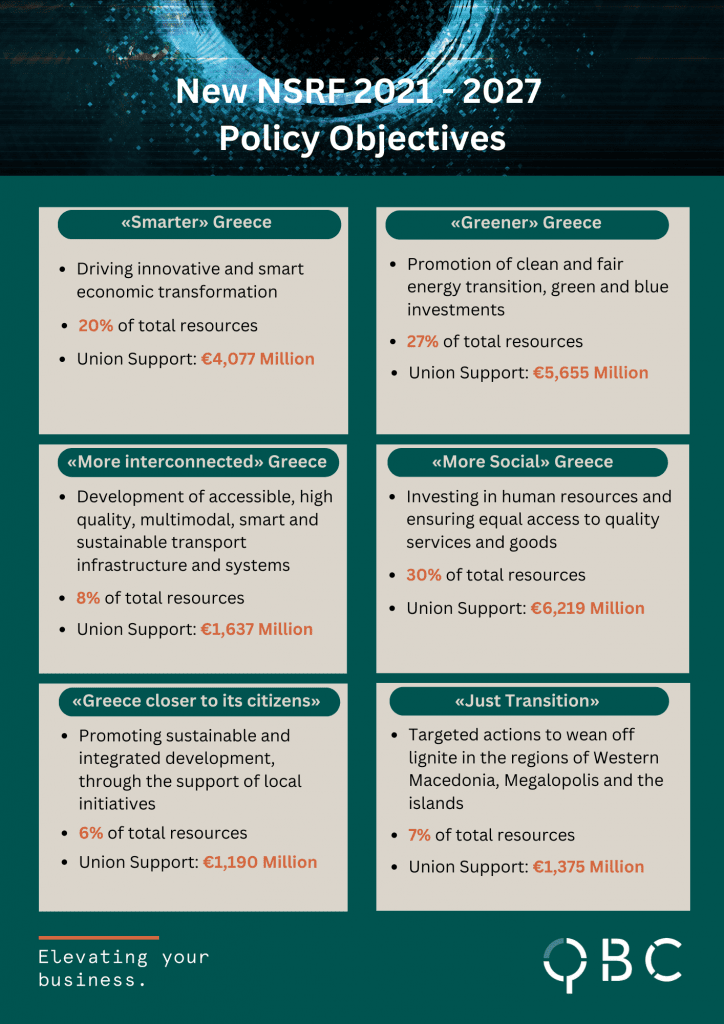
The priorities and the actions that will be implemented are aimed at the fruitful transition to a:
- “smarter” Greece – 20% of resources
- “greener” Greece – 27% of resources
- “more interconnected” Greece – 8% of resources
- “more social” Greece – 30% of resources
- “Greece closer to its citizens” – 6% of resources
- “Just Transition” of areas after de-lignitization – 7% of resources
The new NSRF 2021 – 2027 has a strong development footprint through actions and projects of high added value and with multiple benefits for both the society and the economy – after the pandemic crisis – contributing the most to the start of a new cycle of prosperity for everyone.

Article to read:
The NSRF Programs 2021-2027
NSRF programs 2021 – 2027
- Sectoral Programs 2021 – 2027
- Regional Programs 2021 – 2027
- Territorial Cooperation Programs 2021 – 2027
NSRF Sectoral Programs 2021 – 2027
- Competitiveness
- Human Resources and Social Cohesion
- Digital Transformation
- Transportation
- Civil Protection
- Environment and Climate Change
- Just Developmental Transition
- Fisheries, Aquaculture and the Sea
- Technical Assistance and Beneficiary Support
NSRF Regional Programs 2021 – 2027
- Eastern Macedonia and Thrace
- Central Macedonia
- Western Macedonia
- Epirus
- Thessaly
- Ionian Islands
- Central Greece
- Attica
- Western Greece
- Peloponnese
- Northern Aegean
- Southern Aegean Sea
- Crete
NSRF Territorial Cooperation Programs 2021 – 2027
- Greece – Italy
- Greece – Albania
- Greece – Cyprus
- Greece – North Macedonia
- Greece – Bulgaria
- Balkans – Mediterranean
Article to read:
NSRF Sectoral Programs
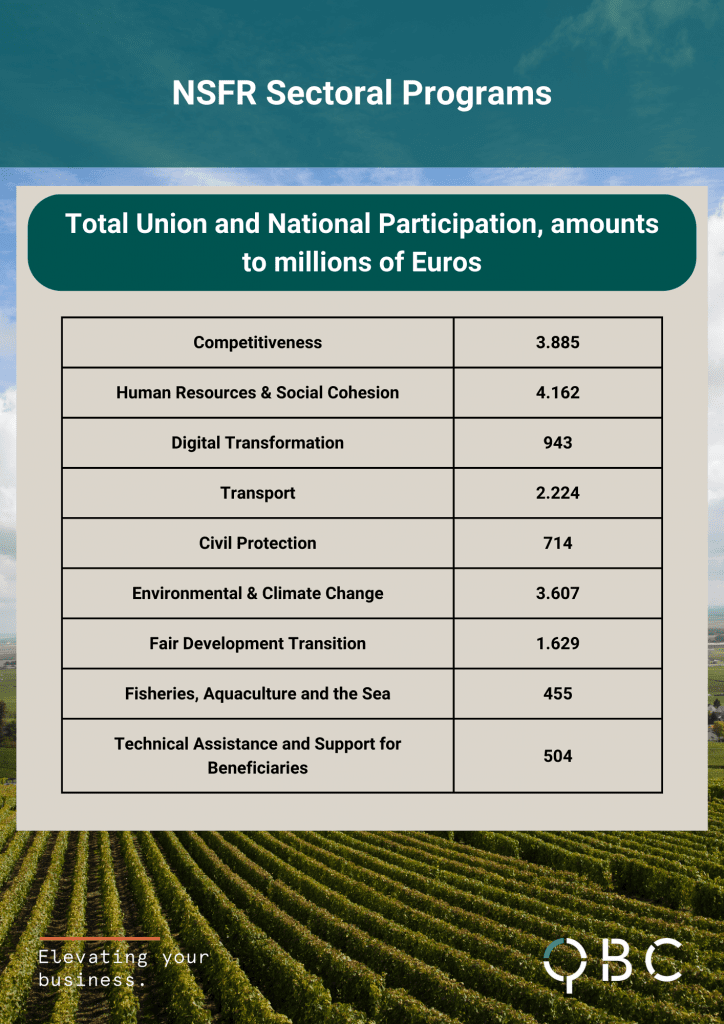
Competitiveness Program 2021 – 2027
The Competitiveness Program is designed as an integrated intervention of the NSRF 2021 – 2027 that will support the productive, competitive and extroverted sectors of the economy in their transition to a development model guided by the Knowledge Economy.
Budget: €3,885 million, of which €2,657.78 million will come from the European Regional Development Fund (ERDF), €431.34 million from the European Social Fund (ESF+) and €795.96 million from National Participation.
Main objective/strategy of the Program: The Program’s aim is to link research and innovation with entrepreneurship and strengthen national and regional advantages, and align with EU policies on digital and green transformation.
4 Main Investment Axes
- Strengthening research and innovation
- Enhancing entrepreneurship and competitiveness
- Improving business access to finance
- Human capital development in the context of developmental transformation
Priority 1 – Strengthening research and innovation
Budget: €772.9 million.
Specific Objective 1: Strengthen research and innovation capacities and exploit advanced technologies.
Action Categories:
- Industrial Research and Technology Development
- Interconnection of companies with research centers/collaborative mechanisms
- Research infrastructures
- Support/promotion of international collaborations
- ESEE governance/support mechanisms
Key groups – targets:
- Existing and new, innovative and start-ups
- Business partnerships with universities and research institutions in strategic sectors of ESEE, Technology Transfer Offices
- Research and academic institutions
Specific Objective 2: Developing skills for smart specialization, industrial transition and entrepreneurship.
Action Categories:
- Targeted training programs for business executives
- Utilization/development of specialized personnel by businesses
Key groups – targets:
- Companies – existing and start-ups
- Executives and research staff from other agencies
Priority 2 – Enhancing entrepreneurship and competitiveness
Budget: €1,589.4 million.
Specific Objective 1: Exploit the benefits of digitization for citizens, companies, and governments.
Action Categories:
- Access to Digital Technologies
- Development of Digital Innovation
Key groups – targets:
- Companies to implement business plans for their digital transformation
- Existing and start-ups developing innovative applications for digital transformation
- Company schemes and partnerships created to advance innovative applications for digital transformation
Specific Objective 2: Enhancing the sustainable growth and competitiveness of SMEs and the creation of jobs in SMEs, including productive investment.
Action Categories:
- Adaptation/modernization of the production process with emphasis on the green transition
- Collaborative schemas – Extroversion
- SME support mechanisms and structures
Key groups – targets:
- Existing and new companies individually or in partnership
- Public and private entrepreneurship support bodies
Priority 3 – Improving company access to finance
Budget: €920.9 million.
Specific Objective 1: Strengthen research and innovation capacities and exploit advanced technologies.
Strengthening with seed capital of company initiatives and support of company establishment and initial development projects, with the cooperation of financial institutions, such as banks, venture capital and business angels. Equifund-style equity financing.
Key groups – targets:
- Existing and new, innovative and start-up companies for the implementation of research, technological development projects
- Newcomers or experienced entrepreneurs who establish and develop knowledge-intensive enterprises with an international horizon of production and commercial activity
Specific Objective 2: Enhancing the sustainable growth and competitiveness of SMEs and the creation of jobs in SMEs, including productive investment.
Action Categories:
- Loans and Guarantees Entrepreneurship Fund
- Capital Participation Fund (Mechanism) for Development
- Green Fund
- Business Internationalization Fund
Key groups – targets:
Existing and under-establishment micro, small and medium-sized enterprises of the eligible economic sectors, developing sustainable business activity in the country
Priority 4 – Human capital development in the context of development transformation
Budget: €530.95 million.
Specific Objective 1: Improving access to employment for all job seekers, especially young people and the long-term unemployed and inactive people, promoting self-employment and the social economy.
Action Categories:
- Adaptation/modernization of the production process with emphasis on the green transition
- Collaborative schemas – Extroversion
- SME support mechanisms and structures
Key groups – targets:
- Population groups that show high rates of specialization based on studies without corresponding professional utilization
- Scientists and qualified human resources, taking into account the contribution of businesses to the strengthening of employment, through the recruitment of employees
Specific Objective 2: Promoting adaptation of workers, businesses and entrepreneurs to change and active and healthy aging, promoting a healthy and appropriately adapted work environment to address health risks.
Action Categories:
- Upskilling or reskilling of professionals, training, certification of knowledge, skills and professional qualifications of workers based on modern recognized standards
- Support workers and the self-employed to adapt to changes in the economic environment and support their mobility
- Business Structural Adjustment Support linked to predetermined directions and planned changes in the organization of each business
- Reskilling – upskilling workers in green transition skills
- Modernization of business support services
- Development of Digital Innovation
Key groups – targets:
- Employed, self-employed and seasonal workers
- Businesses that upgrade human resources skills
- Bundles of Actions of the “Competitiveness Program 2021 – 2027”
Green Transition SME
Financing SMEs to upgrade their production operation and adopt environmentally friendly solutions, with a budget of €700 million.
Digital Transformation of SMEs
Covering the needs of SMEs according to their existing digital and technological maturity in order to integrate modern digital technologies into their production activity, with a budget of €200 million.
Research – Innovate
Connecting research and innovation with entrepreneurship and strengthening the competitiveness, productivity and extroversion of businesses, with a budget of €250 million.
Article to read:
Human Resources & Social Cohesion Program 2021 – 2027
Budget: €4,162 million.
Main objective/strategy of the Program: The Program aims to improve access to employment and to strengthen the employability of all human resources, with particular emphasis on young people up to 29 years old outside of Employment, Education & (EAEK), to promote equal access to quality and inclusive education, training and lifelong learning, addressing material deprivation, ensuring equal access to quality health services, promoting social inclusion.
Key Priorities:
- Horizontal–Systemic Interventions
- Employment and Labor Market
- Education and Lifelong Learning
- Social Innovation Actions
- Food Aid and Addressing Material Deprivation
- Youth Employment
Digital Transformation Program 2021-2027
Budget: €943 million.
Main objective/strategy of the Program: The Program mainly aims to provide new and upgraded public digital services and applications to businesses and citizens, while ensuring privacy and data protection, as well as accessibility, respecting the principle of universal design, in ensuring the interoperability of digital systems and services, in the development of digital platforms to support business activity, in ensuring ultra-high-speed connectivity and meeting digital skills needs in support of the country’s digital transformation, focusing on harnessing and integrating cutting-edge technologies.
A point of reference for the implementation of the Program is the Digital Transformation Bible 2020 – 2025, which includes, among others, the strategic axes of digital transformation: Connectivity, Digital abilities and skills, Digital transformation of businesses, Digital Public Services, Digital Innovation, Use of advanced technologies.
Key Priorities:
- Digital transformation of the public sector
- Enhancing connectivity with high-speed broadband access
- Developing digital skills
Transport Program 2021-2027
Budget: €2,224 million.
Main objective/strategy of the Program: The Program’s vision is to ensure the safe, smooth and economically efficient operation of the transport sector and to strengthen the development of accessible, high-quality, multimodal, climate change-resistant, smart and sustainable infrastructure and transport systems, with the aim to contribute to the response to the recent crisis, the economic recovery, the reduction of disparities between the Regions, and at the same time the pursuit of a green, inclusive, digital and resilient Europe.
Civil Protection Program 2021-2027
Budget: €714 million.
Main objective/strategy of the Program: The Program’s main strategy is the creation of a modern and effective mechanism of civil protection that focuses on prevention, readiness for response and intervention with the aim of protecting the life, health and property of citizens, the environment, the cultural heritage, infrastructure, wealth-producing sources, vital services, material and intangible goods from natural and technological disasters and other threats of related origin, which cause or may cause emergency situations.
Environment & Climate Change Program 2021-2027
Budget: €3,607 million.
Main objective/strategy of the Program: The Program is designed and envisioned to lead us to: “A greener and more resilient Europe with low carbon dioxide emissions, by promoting the transition to clean forms of energy, green and blue investments, circular economy, climate change mitigation and adaptation, risk prevention and management, and sustainable urban mobility’, contributing to the achievement of Policy Objective 2 of the NSRF 2021 – 2027 and the European Cohesion Policy. The Program aims to implement the country’s development strategy in the thematic areas: a) Environment (Protection of the natural environment, Management of liquid – solid waste and promotion of a circular economy, Protection of the aquatic environment and the rational management of water resources, protection from gas pollution and the adverse effects of noise pollution) and b) Adaptation to Climate Change and Energy (Flood protection, prevention – mitigation and response to the effects of Climate Change, Saving – Energy Efficiency, Implementation of the National Plan for Energy and Climate, Promotion of energy production from RES).
Fair Development Transition Program 2021-2027
Budget: €1,629 million.
Main objective/strategy of the Program: The Program in a climate-neutral economy in Western Macedonia and the wider area of Megalopolis focuses on the restructuring of the production system, on the support of human resources and communities affected by de-lignitization, and on mitigating the negative consequences to the environment from mining and power generation from lignite, health and safety, and a distinct category of eligible areas are the islands (North Aegean, South Aegean and Crete), which cover their energy needs mainly from independent oil-fired power plants. Due to the number of islands and thus the fragmentation of these stations, the effects will be limited. However, the targeted and planned transition to climate neutrality of the islands is an opportunity for their economic diversification, in order not to depend almost exclusively on mass summer tourism and the real estate market.
Key Priorities:
- Enhancing and promoting entrepreneurship
- Adaptation of land uses – circular economy
- Integrated Small-Scale Interventions – Smart Communities
- Energy transition – climate neutrality
- Fair labor transition and empowerment of human capital
Fisheries, Aquaculture, and the Sea Program
Budget: €455 million
Main objective/strategy of the Program: The Program has as its vision: “Transition to a sustainable, competitive, blue and at the same time environmentally friendly economy, with an emphasis on knowledge-based decision-making, the introduction of innovation and the exploitation of technological development in the fisheries and aquaculture sectors, and empowering local communities to benefit from the opportunities offered by the sustainable blue economy.
Technical Assistance and Support for Beneficiaries
Budget: €504 million
Main objective/strategy of the Program: The central strategic objective of the Program is the formation and continuous assurance of the appropriate organizational and operational conditions that will contribute to the achievement of the policy objectives of the NSRF 2021-2027 and the individual Programs.
The needs identified and attempted to be covered by the Program can be summarized as follows:
- Need to support and modernize the existing organization and mechanisms for the implementation of the NSRF
- Need for the executive and technical support of all agencies in charge of administration, management, certification, control and monitoring of the implementation of the programs of the new program period,
- Need for horizontal and personalized support for large and smaller NSRF beneficiaries to increase their Administrative Capacity and Administrative Efficiency with the aim of effective management and monitoring of their co-financed actions.
NSRF Regional Programs
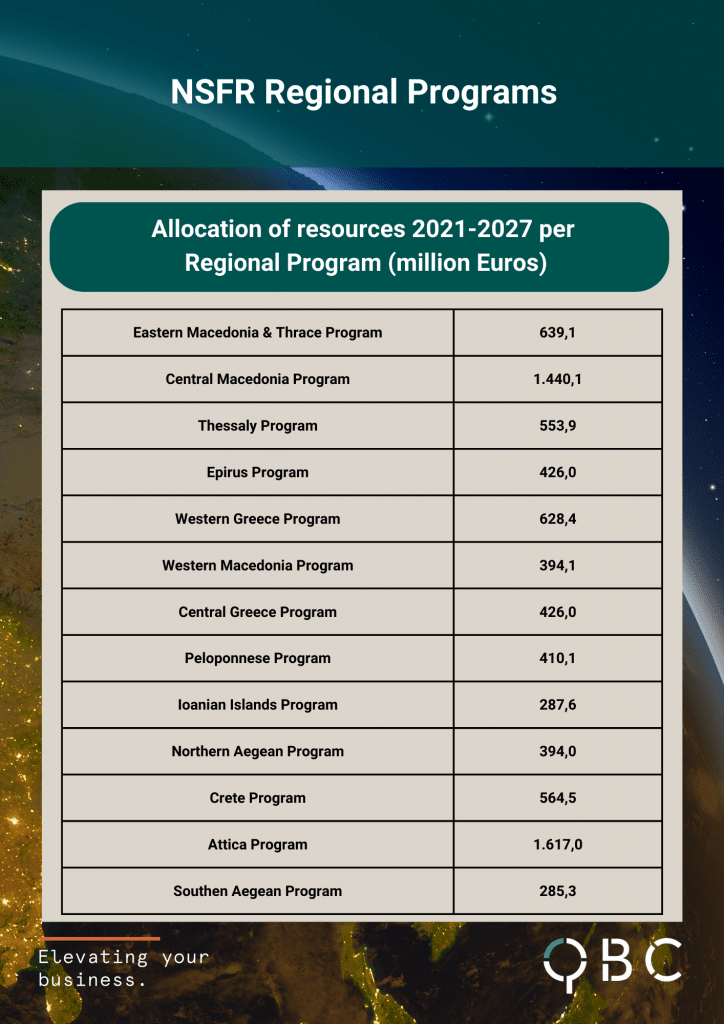
Total Budget: €8,066 million
Strategic Objectives / Actions:
- Strengthening and diversifying the regional economy using research and innovation
- Promoting sustainability, rational and efficient management of natural resources – Tackling Climate Change
- Strengthening social cohesion and human potential
- Enhance mobility
- Supporting sustainable and integrated spatial development
How can QBC help you?
QBC Business Consultants have the expertise to guide you through your successful integration into Horizon Europe 2021-2027 interventions.
Our support will take place in 4 distinct phases.
Phase 1 – Investment Plan Overview/Development and Evaluation
Phase 2 – Apply for the Horizon Europe 2021-2027 interventions
Phase 3 – Support during communications with stakeholders during the submission and evaluation of applications
Phase 4 – Support during the implementation of your investment plan
For more information on national and european subsidies and grants, you can contact us by phone at 216 900 7576 or submit a contact request and one of our Consultants will serve you immediately.